Biosignal processing comes to the Web
Building applications with biosignals on the web has historically meant building everything from scratch. From BLE (Bluetooth Low Energy) device transports, signal processing pipelines, and protocol decoders, one thing is clear: there is no universally standardized workaround.
In fact, in brain sciences, most tooling still assumes MATLAB and a six-figure hardware budget.
For builders, this means that if you want neural signal data or contactless biosignal acquisition, you've had to piece it together yourself. This arduous process would typically include porting research code, fighting Web Bluetooth APIs, and settling for slow JavaScript implementations of algorithms that need real performance. Clearly, this is an area that has not yet caught up to 21st century technology standards.
With Elata SDK, we're enabling a new class of applications built on top of anonymous neural signaling that are fully abstracted. You don't need to have expensive hardware to use apps. In fact, you don't need hardware at all, apps can be used contactlessly through your phone or computer's native camera.
The browser is the most universal application runtime on earth. It's cross-platform by default, requires no installation, and reaches anyone via a URL. But biosensing has never lived on the web: the computation has been too heavy for JavaScript, the device protocols too low-level for most web developers, and the signal-processing expertise concentrated in academic labs, not npm packages.
Elata SDK solves this by doing the hard work in Rust, compiling to WASM, and exposing it through TypeScript packages that feel like any other npm dependency. The performance is near-native and the developer experience is fully abstracted, it's just an npm install.
Because everything runs client-side in WASM, raw sensor data never has to leave the device. The browser isn't just the delivery mechanism, it's the processing environment.
As this is the initial release of the Elata SDK, our EEG packages work strictly with Muse headsets, most notably the Muse Athena S and the Muse 2.
The Stack
Currently the Elata SDK is comprised of three packages, each targeting a different sensing modality:
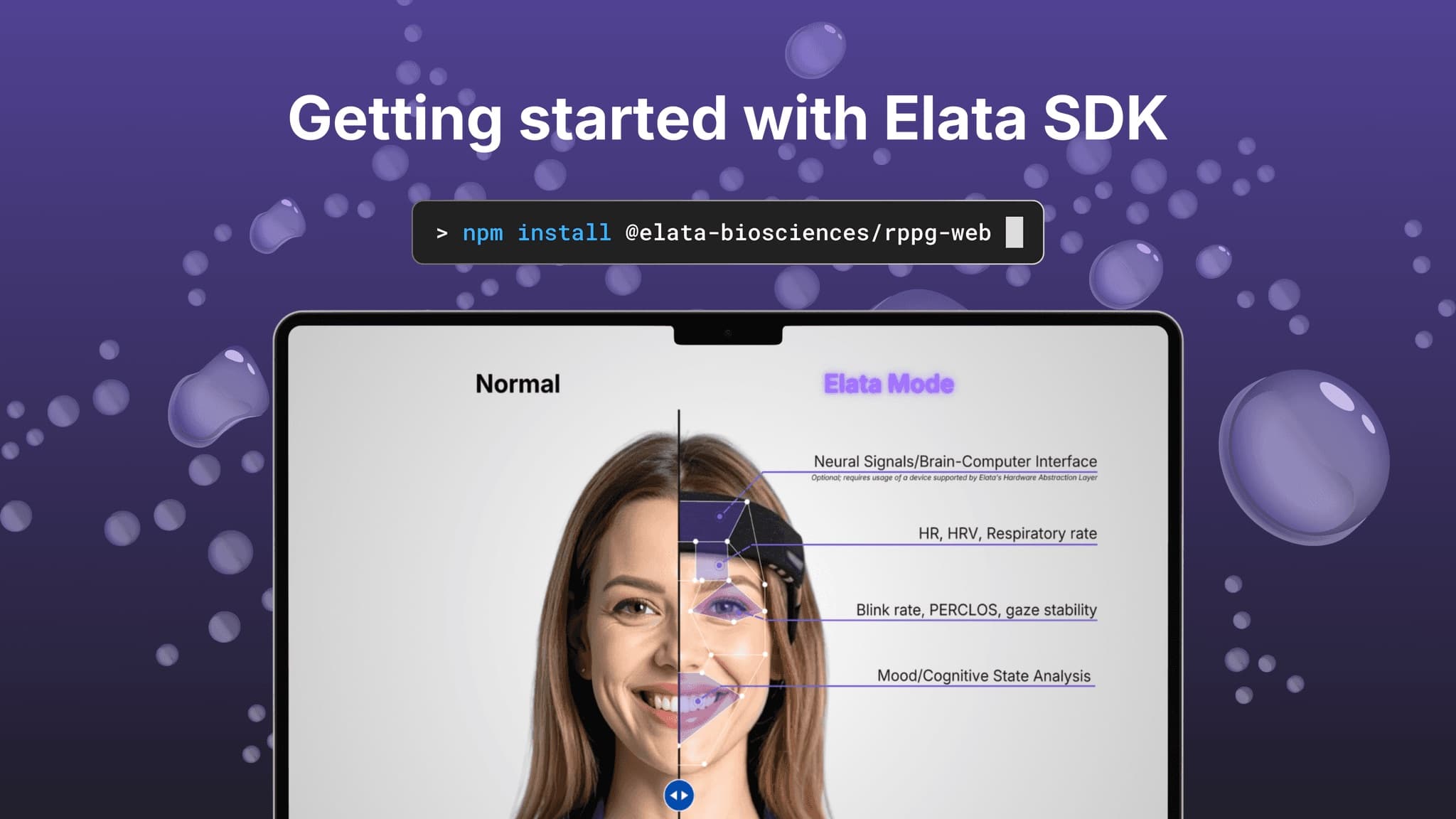
@elata-biosciences/rppg-web, processes webcam video to extract biosignals. Heart rate is detected through remote PPG signals, plus facial affect and sentiment analysis. No hardware is required for this modality.@elata-biosciences/eeg-web, handles EEG signal processing. Band power extraction across all standard frequency bands (delta, theta, alpha, beta, gamma), FFT, filtering, and two built-in analysis models: an Alpha Bump Detector that tracks relaxed vs. alert state transitions, and a Calmness Model that outputs a continuous 0-100% score from the alpha/beta power ratio.@elata-biosciences/eeg-web-ble, the Web Bluetooth transport layer for HAL-compatible EEG headbands. It handles device discovery, BLE pairing, and protocol decoding, then emits clean, normalized frames that pipe directly into signal processing.
Together, the packages cover contactless biosensing (camera), neural signal physiology (EEG), and behavioral analysis, all from the browser, all from open source.
Elata SDK's core is written in Rust and organized as a workspace of fourteen crates spanning the signal pipelines above. Rust compiles to WebAssembly (WASM) for the browser and to native libraries for iOS, Android, and desktop via UniFFI. The TypeScript packages wrap the WASM bindings with ergonomic APIs.
Why This Matters
Hardware Abstraction Layer (HAL). The EEG pipeline is built on HAL traits that anyone can implement. Because Elata SDK is open-source, contributors can plug any at-home neural sensing device into the SDK by implementing these traits. For the initial release, the HAL works with Muse's line of headbands and a synthetic device for testing, but the interface is open for any hardware to follow.
Synthetic device for development. The SDK ships a configurable synthetic EEG source with signal profiles (relaxed, alert, and so on). You can build and test your entire application without owning a device, build now, ship to people who already have hardware, and swap to real hardware whenever you're ready.
WASM-optimized builds. The release profile uses aggressive optimization with LTO, explicitly tuned for small binary size. This is a browser-first SDK; bundle size matters and we treat it that way.
One codebase, every platform. The Rust core compiles to WASM for browsers, native Swift for iOS, native Kotlin for Android, and runs directly on desktop. Write your signal processing once, and ship everywhere.
Privacy by Design
All processing happens locally on-device. Raw sensor data, whether camera frames or EEG samples, is reduced to physiological metrics in the browser. What comes out the other end is a number, not a biometric.
A band power reading or a heart rate value carries no identity. Identity is lost in the pipeline because the pipeline was never looking for it. Nothing leaves the browser unless the developer explicitly decides it should.
Getting Started
# Camera-based biosensing (no hardware needed)
npm install @elata-biosciences/rppg-web

# EEG processing + headband connectivity
npm install @elata-biosciences/eeg-web @elata-biosciences/eeg-web-bleimport { Muse, EegProcessing } from "@elata-biosciences/eeg-web";Full API documentation and usage examples live in the GitHub repository and each package's source directory.
Use Cases
The entire point of porting this capability to the web is to make biosignal and brain-interfacing applications ubiquitous. We want to lower the barrier to entry so web and application developers can ship biosignal apps they previously couldn't, and because processing happens on user devices, that includes uniquely sensitive use cases like brain-compatible AI applications, games, and biometric analysis. A few concrete examples:
- A browser-based meditation app with live EEG biofeedback. Connect a headband via Web Bluetooth, stream alpha/beta powers, and drive a visual or audio feedback loop.
- A stress monitor that runs on your camera. Track HR, HRV, and facial micro-expressions over a work session with no wearables at all, through a mobile app, browser extension, or website.
- A neuroscience experiment that runs entirely in Chrome. Recruit participants via a link. They grant camera or Bluetooth access, complete the protocol, and you collect derived metrics, not raw biometric data. No installation, no IT department, no lab visit, and no sensitive data pipeline to secure.
- A game where cognitive state drives gameplay. Pipe alpha-state detection into game mechanics, relaxation charges a power meter, focus sharpens aim. The input device is your brain.
These are not future plans. They are buildable today, with the packages published right now. And with the barrier to entry this low, builders can use modern AI coding tools to ship apps in remarkably short timeframes.
Open Source & Next Steps
Elata SDK is open source under MIT. Anyone can use it. For this initial release, we're especially looking for:
- Builders who will install these packages and ship something. We want to see what happens when biosensing is as easy as importing a library.
- Contributors who want to add device drivers, signal-processing algorithms, or new analysis models to the core.
- Researchers who need browser-based experiment tooling and are done waiting for the MATLAB-to-native-app pipeline to modernize.
- Hardware developers who want their hardware to work with an open ecosystem rather than a proprietary SDK that only they maintain.
Here's where to start:
- GitHub: Elata-Biosciences/elata-bio-sdk
- @elata-biosciences/rppg-web
- @elata-biosciences/eeg-web
- @elata-biosciences/eeg-web-ble
The infrastructure for biosensing on the web didn't exist before. Now it does, open source, on-device, and non-identifying by design. What will you build?